Hybrid Quantum Optics
The Hybrid Quantum Optics (HQO) project investigates how ultracold atoms can be used to control the quantum motion of microscopic mechanical resonators. Our approach combines two systems with complementary strengths: Rydberg atoms, whose giant electric dipole moments enable exceptionally strong and tunable interactions, and high-quality acoustic resonators that can store microwave-frequency vibrations, or phonons, for remarkably long times.
By coupling these systems together, we aim to create a hybrid quantum platform in which atoms can cool, manipulate, and ultimately prepare quantum states of mechanical motion. Such atom–phonon interfaces combine the exquisite quantum control available in atomic physics with the scalability of chip-based solid-state devices, opening new opportunities for quantum science and future quantum technologies.
In the following figure you can see a schematic of the experimental setup: a cloud of ultracold Rubidium atoms trapped above the resonator on the atom chip are excited to Rydberg state by counter-propagating probe (Ωp) and control (Ωc) laser beams and positioned so that the Rydberg atoms can couple to an electric field (E) generated by the electromechanical resonator.


A cloud of ultracold Rubidium atoms is trapped above the chip and excited to Rydberg state by counter-propagating probe (Ω_p) and control (Ω_c) laser beams. The atoms couple to the electric field (E) generated by the electromechanical resonator.
Fabricated atom chip which will be used to trap the atoms on a wire-trap on a chip and interface rubidium Rydberg atoms with the microwave waveguide resonator on the chip - the HBAR is not yet implemented here.
Our Mechanical Resonator: High-Overtone Bulk Acoustic Wave Resonator (HBAR)
The mechanical element at the heart of our experiment is a high-overtone bulk acoustic wave resonator (HBAR). It consists of a high-purity sapphire substrate coated with a thin piezoelectric aluminium nitride (AlN) layer. When driven electrically, the piezoelectric layer launches acoustic waves that are reflected within the substrate, forming high-overtone standing-wave resonances at microwave frequencies. Owing to the exceptional acoustic properties of sapphire, these resonators can exhibit quality factors approaching 10⁷ [Yang et al., "A mechanical qubit," Science 386, 783–788 (2024)].
Our HBAR is fabricated and sent to us from Yiwen Chu's group, who first demonstrated coupling a superconducting qubit to the phonon modes of an HBAR [Chu et al., "Quantum acoustics with superconducting qubits," Science 358, 199–202 (2017)], and who have since, now at ETH Zürich, pushed this hybrid platform to state-of-the-art coherence and control [Yang et al., Science 386, 783–788 (2024)]. Through this collaboration, we benefit from both their fabrication expertise and resonator technology.
The acoustic strain inside the piezoelectric layer generates an oscillating electric polarization, producing an evanescent electric field that extends several tens of micrometres above the chip surface. Although the mechanical displacement itself is minute, this electric field provides an efficient interface to nearby Rydberg atoms. Atoms trapped approximately 50 μm above the resonator can therefore interact directly with the HBAR's phonon mode through their enormous electric dipole moments.
For our resonator geometry (32 μm acoustic mode waist, 420 μm sapphire substrate) and the ⁸⁷Rb 85S–85P transition at 5.8 GHz, we calculate a coherent atom–phonon coupling strength of approximately Ω/2π ≈ 20 kHz, which is comparable to the dominant decoherence rates in the system and therefore sufficient to enable coherent quantum control and active cooling of the mechanical resonator.


COMSOL simulation of the piezoelectric field. The piezoelectric transducer (Lpiezo = λ/2) sits atop the bulk acoustic-wave substrate (Lsub > λ), generating an electric field E above its surface that couples to the Rydberg atoms with strength g₁. The inset shows the simulated field magnitude and field lines.
Photograph of one of the fabricated HBAR chips, provided by the Chu group at ETH Zürich. The piezoelectric domes sit on top of a saphire substrate. In our experiment, only the central dome will be used.
Cooling with Rydberg Atoms
To control the resonator, we use ultracold ⁸⁷Rb Rydberg atoms as an engineered quantum refrigerant.
Laser excitation prepares the atoms in a highly excited nS Rydberg state using a coherent two-photon transition. Through resonant electric dipole coupling, the atoms can absorb a phonon from the HBAR, transferring them into a neighbouring nP state. This excited state is engineered to decay rapidly, removing the absorbed energy from the system before it can be transferred back into the resonator. In this way, the atoms act as a one-way channel for phonons, continuously extracting mechanical energy from the HBAR.
Rather than relying on a single atom, the resonator interacts collectively with an ensemble of ultracold atoms. This collective enhancement significantly increases the effective cooling rate while remaining compatible with realistic experimental atom numbers.
Numerical simulations using experimentally achievable parameters predict that this protocol can cool the HBAR from its initial cryogenic thermal occupation to sub-kelvin effective temperatures, substantially reducing the remaining phonon population and bringing the resonator close to its quantum mechanical ground state.


Level scheme of the cooling cycle: atoms start in |G⟩ and are excited to |W⟩, which can dephase to |D⟩; both |D⟩ and |W⟩ couple via Ω_Hbar to |nP⟩, hybridized with the resonator's phonon states. Fast decay from |nP⟩ to |E⟩ and then to |G⟩ closes the cycle, extracting phonons and cooling the HBAR.
Numerical simulation showing the phonon occupation during cooling: the phonon number ⟨n⟩ decays from an initial thermal occupation of ~12 toward steady state, reaching n_final = 1.754 (T = 617 mK) for N = 1 atom and n_final = 0.752 (T = 329 mK) for N = 2 atoms. This illustrates cooling into the sub-Kelvin regime, with faster and deeper cooling achieved by using more Rydberg atoms simultaneously.
Experimental Platform
Realizing this hybrid system requires the integration of ultracold atoms, superconducting microwave technology, and cryogenic operation within a single experiment.
Atoms are first collected in a room-temperature magneto-optical trap, where approximately 1.5 × 10⁹ ⁸⁷Rb atoms are loaded within one second at temperatures of around 50 μK. The atoms are then transported magnetically into a separate cryogenic science chamber, allowing efficient atom production while maintaining the ultrahigh vacuum and low temperatures required for long coherence times.
Inside the science chamber, a superconducting atom chip provides magnetic trapping, Rydberg excitation, electric-field control, and field ionization. The HBAR is integrated directly onto this chip and operated inside a closed-cycle cryostat with a base temperature below 5 K. The cryogenic environment suppresses thermal phonons in the resonator and strongly reduces blackbody-induced transitions of the Rydberg atoms, providing ideal conditions for coherent atom–phonon coupling.
The entire room-temperature part of the apparatus — MOT chamber and magnetic transport— is mounted on a linear rail system, allowing the whole setup to be moved relative to the fixed cryostat. This lets us pull the vacuum system back and open the cryostat to exchange atom chips without having to redesign or realign the rest of the experiment, considerably speeding up the iteration cycle between chip generations.

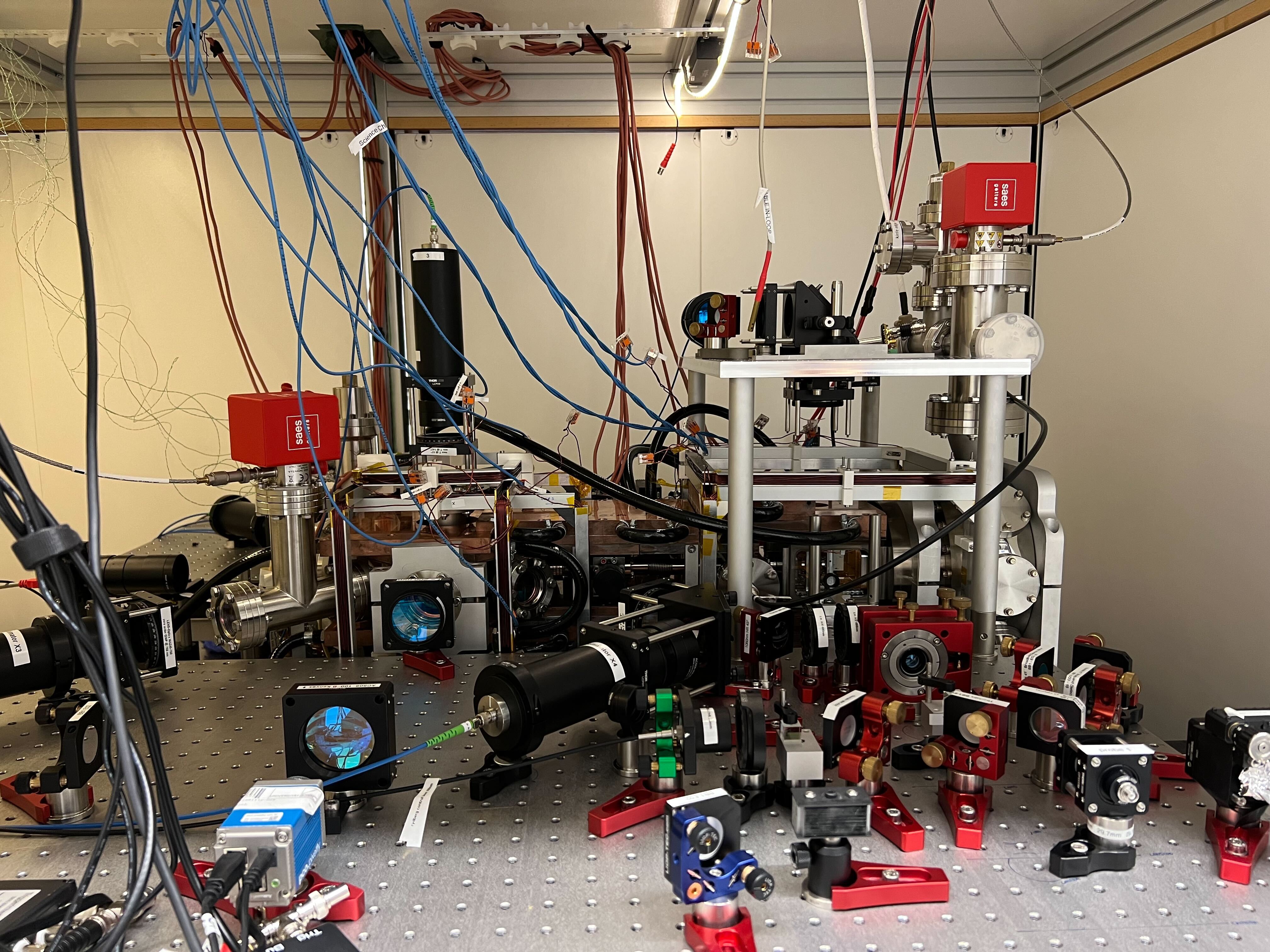
Drawing of the experimental setup without the cryostat which would be added on the right. The system consists of a MOT chamber where the atoms are prepared and a Science Chamber where the experiment is going to be perfomed. A magnetic transport is used to transfer the atoms from one chamber to the other.
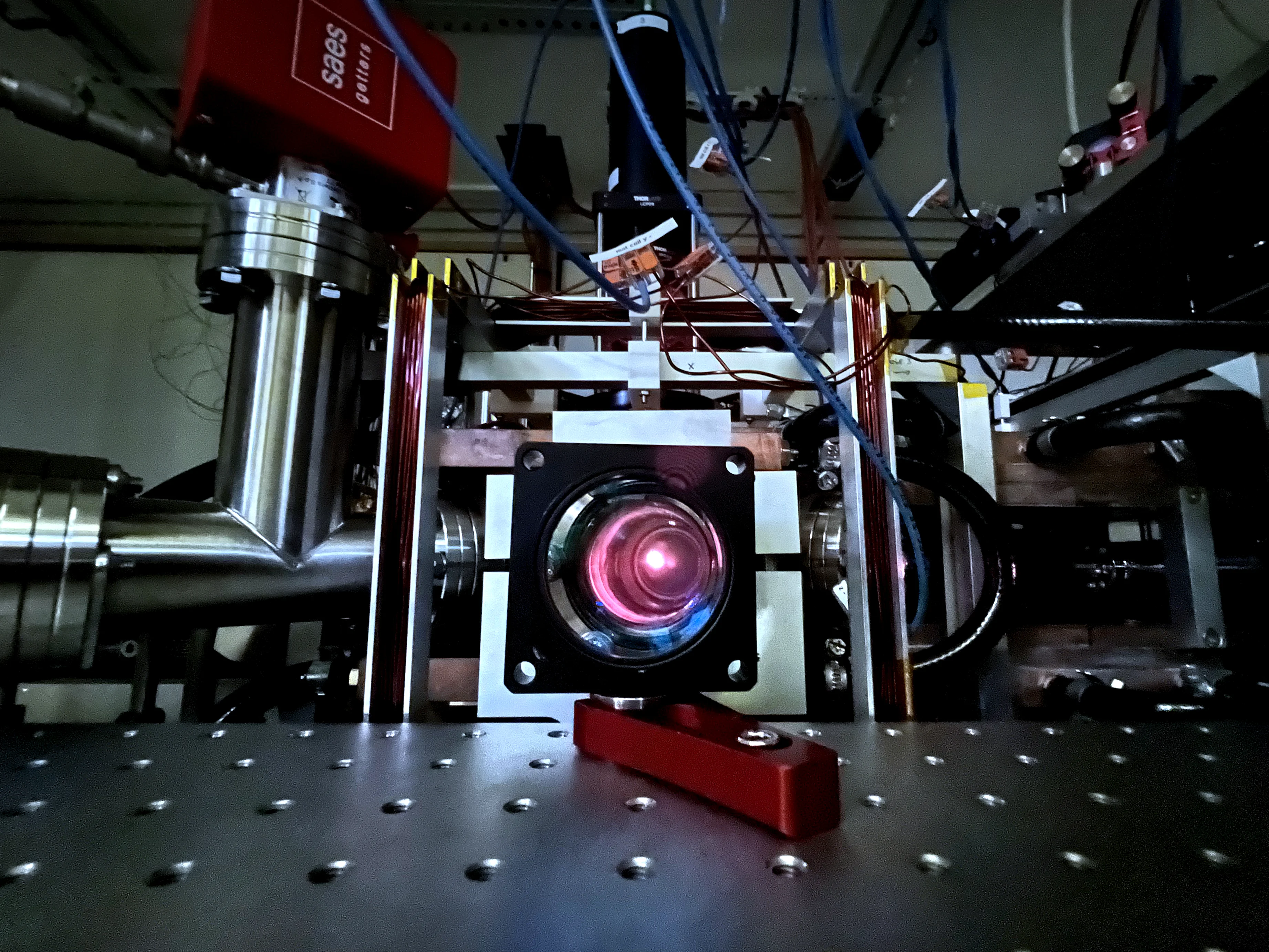
The is a photograph of the experimental setup that is drawn in the figure next to this. Currently, the cryostat is about to be added on the right side. The optics visible is used for the MOT, Rydberg excitation and imaging of the atoms.


Outlook
The long-term goal of HQO is to establish a versatile hybrid quantum platform that combines the coherence and controllability of neutral atoms with the scalability of chip-based mechanical devices. Beyond demonstrating active cooling, future experiments will explore coherent atom–phonon state transfer, the preparation of non-classical mechanical states, and new interfaces between atomic and solid-state quantum systems. Such hybrid architectures could provide new building blocks for quantum information processing, quantum sensing, and the study of quantum phenomena in macroscopic mechanical systems.