Rubidium Rydberg Nonlinear Quantum Optics
The Rubidium Quantum Optics project (RQO) explores how the strong interactions between atomic Rydberg states in an ultracold gas of rubidium can be used for quantum optics. The simple level structure of the alkalis and the established techniques for cooling and trapping Rb make this element a natural choice for exploring Rydberg electromagnetically induced transparency (EIT) and nonlinear quantum optics.
For our experiments, we typically first cool a dilute rubidium gas in a magneto-optical trap (MOT), then transfer it to one or more optical dipole traps (ODTs) and cool it further to a few microkelvin.
We probe the cold gas with a very weak probe-beam at 780 nm and employ a classical control field at 480 nm to couple the intermediate excited state to Rydberg states. The Rydberg-Rydberg-interactions between the atoms and the resulting excitation blockades are mapped onto the probe field. This allows us to create strong optical nonlinearities at single photon level for the probe light.
Individual probe photons are detected using a Hanbury Brown–Twiss setup equipped with single photon counting modules. This enables us to investigate photon–photon correlations. In addition, we have the option to field-ionize the Rydberg atoms and detect the created ions. The detection time of the ions gives us information about the spatial distribution of Rydberg excitations in the rubidium gas. We also utilize the ion-statistics to determine the number of Rydberg excitations in the system. In addition, we upgraded our setup with an EMCCD camera that allows us a readout of single photons together with their spatial distribution.

The vacuum chamber with rubidium atoms in a magneto-optical trap.
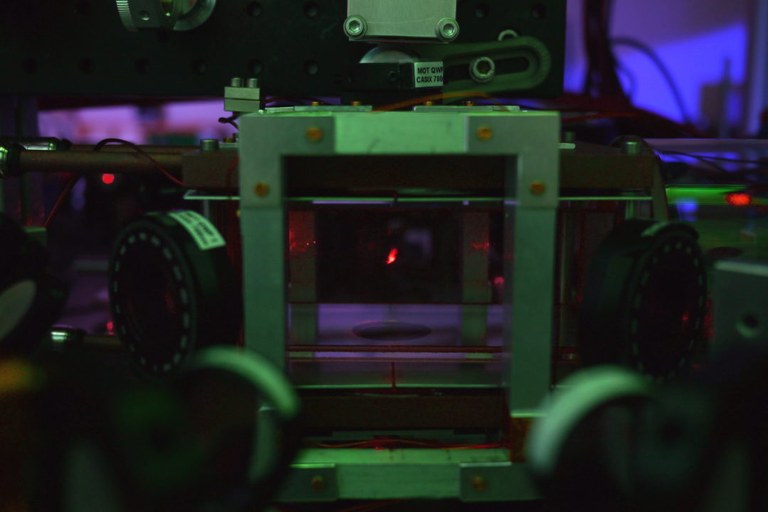
Another view of the fluorescence of the rubidium atom in the magneto-optical traop.
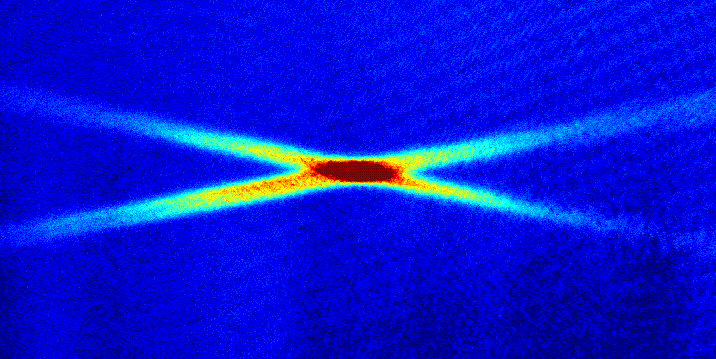
An absorption image of rubidium atoms in our
The first demonstration of quantum-optical effects with our rubidium experiment was done in 2013, and was followed by the demonstration of a single-photon transistor in 2014. The transistor was implemented by using the Rydberg excitation blockade between states of different principal quantum numbers. Since 2016 the RQO experiment has mainly been focusing on so-called Rydberg superatoms: atomic ensembles collectively excited to a Rydberg state. With the superatoms we have investigated two- and three-photon correlations, investigated the excitation decay which reveals the internal dipole-dipole dynamics, and demonstrated deterministic subtraction of single or few photons from an input pulse.
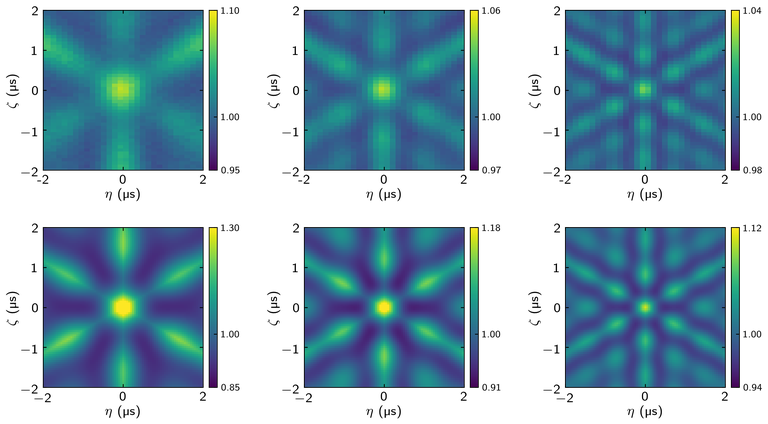
Three photon correlation function. Top row shows experimental results, bottom row shows corresponding theory.
Transverse photon-photon interactions
With the recent addition of an EMCCD camera to our setup, we are currently investigating the interactions among multiple polaritons within a large atomic cloud. While the single-photon counters provide only temporal resolution, the EMCCD camera adds spatial resolution. This enables us to investigate transverse interactions, which theoretically lead to deformations in the spatial distribution of transmitted probe photons. To facilitate these transverse interactions, we must ensure that multiple superatoms can coexist in the transverse plane. This requires either decreasing the principal quantum number of the Rydberg state — which reduces the blockade radius and thus the superatom size — or increasing the probe beam waist to allow superatom formation over a larger area. To achieve this, we upgraded our experimental setup from the one-dimensional chain to the two-dimensional cylindrical polariton configuration that allows transverse interactions.

Schematic of the transition from a one-dimensional chain of polaritons to the two-dimensional cylindrical configuration. The now enabled transverse interactions change the spatial pattern on the EMCCD camera.
Near future: cavity-coupled superatoms
Previous experiments have been constrained by the limited photon-atom interaction strength. To address this limitation, we are upgrading our setup by constructing a cavity around single or multiple superatoms. We plan to integrate a low-finesse, rectangular, traveling-wave (“ring”) cavity into our existing rubidium Rydberg experiment. The resonator is a macroscopic cavity located outside the vacuum chamber and consists of four planar mirrors and two intracavity lenses that produce the cavity waist. The traveling-wave geometry removes the standing-wave modulation of a linear resonator, while the lenses ease the alignment procedure and can be placed close to the existing vacuum chamber to create a tight focus of about 5µm. The non-planar geometry additionally allows independent control of the transverse-mode structure and the polarization eigenmodes, enabling nearly circular polarized eigenmodes. The cavity is actively stabilized to a 787nm laser that is in turn locked to an ultra-stable Fabry–Perot reference cavity. Based on our current design and data from the existing experiment, we anticipate a collective cooperativity of about 100. This platform opens a route toward cavity-mediated interactions between Rydberg atoms, combining the enhanced coupling of a small-waist ring cavity with the collective properties of Rydberg superatoms.

Planned experimental upgrade with 2D MOT assembly and cavity around the science chamber.
Results
2021: Controlled multi-photon subtraction with cascaded Rydberg superatoms as single-photon
2020: Observation of collective decay dynamics of a single Rydberg superatom
2020: Photon propagation through dissipative Rydberg media at large input rates
2018: Observation of Three-Body Correlations for Photons Coupled to a Rydberg Superatom
2018: Photon Subtraction by Many-Body Decoherence
2017: Free-Space Quantum Electrodynamics with a single Rydberg superatom
2017: Electromagnetically induced transparency of ultralong-range Rydberg molecules
2016: Single-Photon absorber
2016: Enhancement of single-photon transistor by Stark-tuned Förster resonances
2015: Dipolar Dephasing of Rydberg D-state polaritons
2014: Single-Photon transistor
The Rubidium experiment has moved multiple times since it was born in 2012. Check our photos to see the history.
The Rubidium team has open positions and we offer student projects. Check it out!